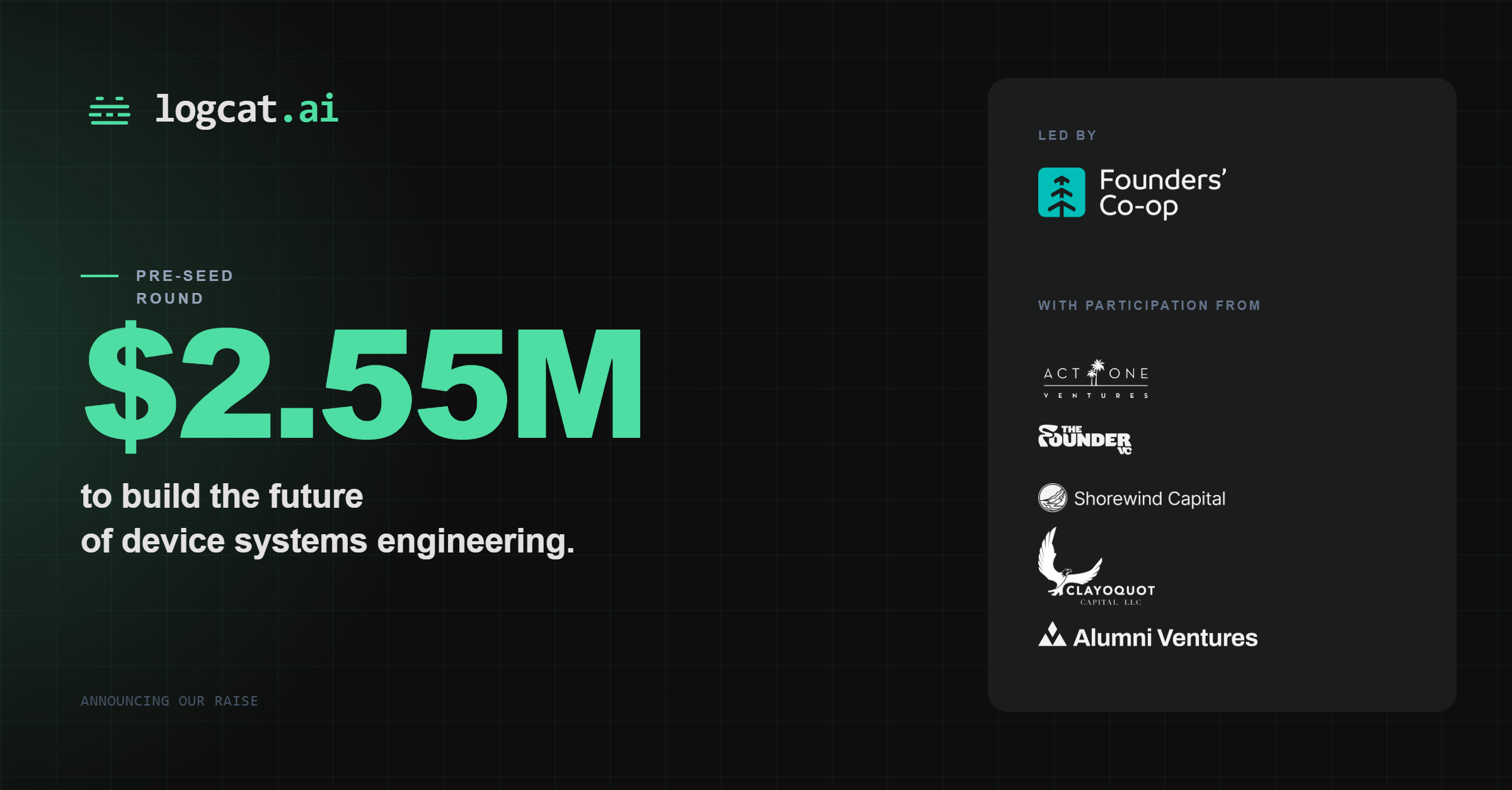
logcat.ai raises $2.55M to build the future of device systems engineering
An AI-native platform for autonomous Android and Linux device systems engineering.
Building an operating system for a device is one of the hardest jobs in software. It spans every layer at once, the modem, the kernel, the bootloader, the middleware, the build system, and each demands its own deep expertise. A single bug can cross all of them, so resolving even one issue can take a rare engineer who understands the whole stack end to end. Those engineers are few, and the work only gets harder with every new chipset baseline, every Android release, and every custom Linux build.
The result is that building and shipping device software is slow and expensive, and the shortage of people who can do it makes it worse. Companies either hire specialists across every layer, which is hard and costly, or lean on vendors who face the same shortage. The bottleneck travels up the chain, and everyone ships late. Meanwhile, the last two years of AI have transformed software engineering nearly everywhere except here: the wave that accelerated the app layer never reached the OS layer, where the work is too specialized and too cross-cutting for general-purpose tools.
That is the gap logcat.ai is built to close. Today the company is announcing a $2.55M pre-seed round to bring autonomous engineering to the OS layer.
This isn’t only phones. The same cross-layer problem shows up in vehicles, robots, network and telecom equipment, and embedded hardware, anywhere Android or Linux runs on real silicon.
The platform runs on Delta, an investigation engine that reads the specialized traces device engineers live in, works across all of them at once to find the root cause of a problem, and maps that cause directly into the codebase to recommend a fix. (read how Delta works →)
Since launch, logcat.ai has served hundreds of engineering teams through its beta, analyzed over 10 billion lines of trace data, and run thousands of autonomous investigations, surfacing upstream fixes for cross-layer issues that are extraordinarily hard to trace manually. That includes the open-source community: through the logcat.ai Community program, the company funds free, full-featured access for developers building non-commercial open-source OS projects.
That is the first step toward a larger goal: a single platform that carries the entire lifecycle of building and maintaining an OS, diagnosing what breaks, fixing it, validating changes against every incoming update, and eventually building cross-layer features from a plain-language description. One system, running in the developer’s own environment, where today there are a dozen disconnected tools and a constant search for people who can hold them all at once.
The round is led by Founders’ Co-op, with participation from Act One Ventures, TheFounderVC, Shorewind Capital, Clayoquot Capital, and Alumni Ventures.
“We’re moving toward a world where software and intelligence extend far beyond our laptops and phones, yet the tooling to build high-quality products for that world is still missing. That’s why I’m incredibly excited to be working with the team at logcat.ai — one of the only teams in the world truly up for the challenge.”
— Aviel Ginzburg, General Partner, Founders’ Co-op
logcat.ai was founded by Varun Chitre and Tarun Vashisth, who worked together as founding engineers at Esper. Varun brings more than 13 years in device systems engineering, hardware bringup, porting new Android releases and Linux kernels onto legacy hardware, and work as a LineageOS maintainer. Tarun has led multi-OS engineering teams across Android, Linux, and iOS, and brings a background in scalable distributed systems.
If you’re losing days to cross-layer debugging, in the middle of an OS bringup, or want to spend the next few years on this problem, logcat.ai wants to hear from you. There’s a button on every page of the site, or reach the team directly at founders@logcat.ai.
About logcat.ai
logcat.ai is an AI-native platform for autonomous Android and Linux device systems engineering, from smartphones to vehicles, robots, network and telecom equipment, and embedded hardware, built to diagnose, fix, and eventually validate and build across every layer of the operating system stack. Founded in 2025 and based in Seattle and Bengaluru, the company is backed by Founders’ Co-op, Act One Ventures, TheFounderVC, Shorewind Capital, Clayoquot Capital, and Alumni Ventures. Learn more at logcat.ai.
About Founders’ Co-op
Founders’ Co-op is the leading seed-stage investment fund in the Pacific Northwest, helping extraordinary founding teams build companies that the best venture capital firms in the world choose to back. Founded in 2008, the firm was an early backer of companies including Remitly, Outreach, and Auth0.